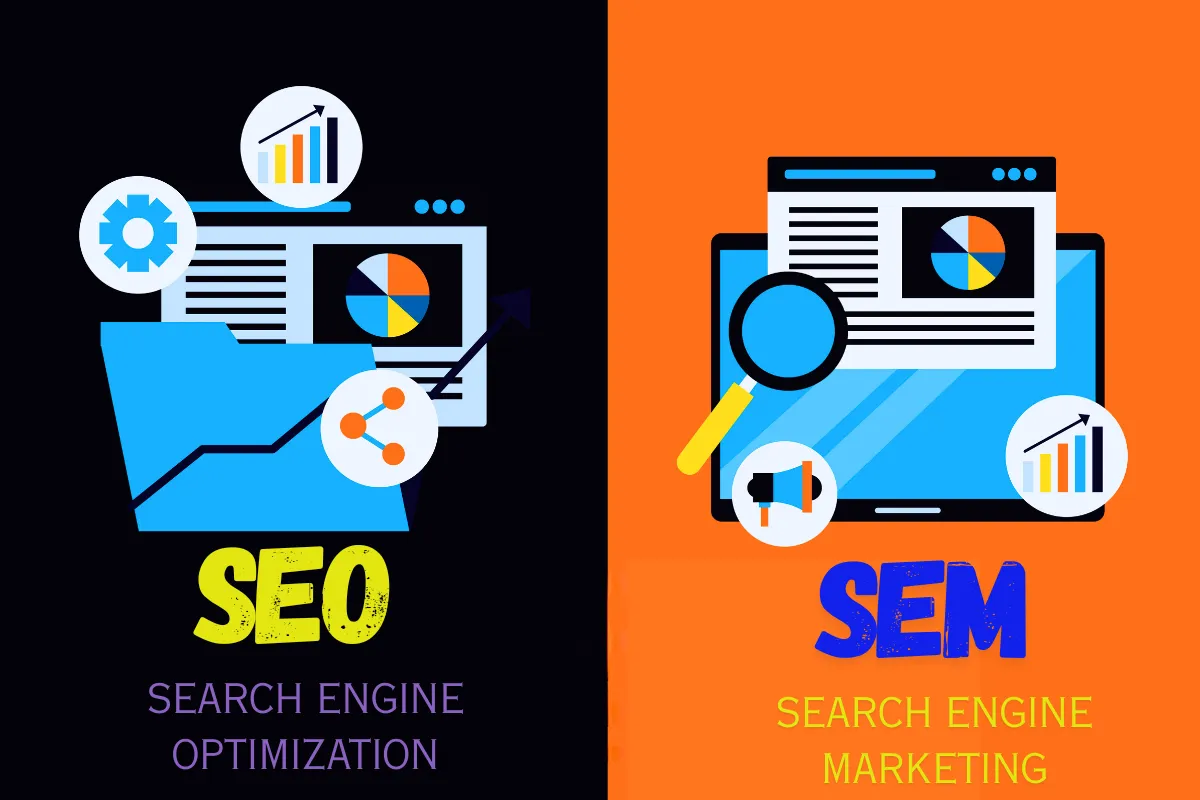
The vibrant environment of digital marketing is where the concepts of SEO and SEM come into play in ascertaining your success on the internet. Simply put, search engine optimization (SEO) and search engine marketing (SEM) provide traffic to a site. They are setting the digital world differently. Here in this blog, we will break down the codes of SEO and SEM, compare them, and assist you in deciding the correct plan to follow when you have a different business. The key to the maximum potential of your digital activities is the understanding of the dynamics of SEO vs SEM.
Search Engine Optimization (SEO) refers to the art and science of increasing the visibility of a given website in a search engine results page (SERP) through organic means. This is to encourage the right traffic without incurring any click costs. SEO is the process of making sure that your site, in terms of its content, structure, and technical aspects, makes your pages helpful and ranks on top of the search engines such as Google, Bing, and Yahoo.
Relevant content writing, brilliant keyword addition, good site structure, building backlinks, page loading speed, using meta tags, and maintaining technical SEO, such as sitemaps and schema markups, are some of the key ranking factors in SEO. Google has also provided an introductory tutorial on the basics of SEO.
SEO is concerned with natural traffic. Visitors come to your site not because you paid for ads, but because your content answers their search intent. Over time, your traffic grows as your site gains authority and trust.
Search Engine Marketing (SEM) is the practice of advertising your site through paid search engine advertising. SEO is free by nature, whereas SEM demands a budget to bid on ad placement. SEM can provide instant visibility in the search results for the search words selected. It commonly employs platforms such as Google Ads or Microsoft Advertising.
With SEM, you make budgets, select keywords, create target audiences based on location or device, and control advertisement creatives. Due to this reason, the results are quantifiable and rapid.
We will contrast them at crucial points to help you decide which is best suited to your business.
SEO is a long game. Raising rankings and traffic drastically may take several weeks or months. SEM gives immediate results. Once your campaign is live, people can immediately start clicking your advertisements.
SEO does not involve payment per click. The expenditures include the development of content, the enhancement of sites, and SEO services.
SEM is paid. You pay for each click (PPC). The stiffer the competition for a keyword, the higher its costs.
SEO requires algorithms and is slower to respond to. Rankings take a long time to react to changes.
SEM is flexible. You are able to stop or edit campaigns in real-time, adjust bids, keywords, or ad copies to your requirements.
SEO aims at the user using keywords and purpose. A match between the content you create and search queries will result in your attraction.
SEM allows precise targeting. You can target demographics, location, device, and user behavior, and narrow your advertisements to particular users.
In SEO, your presence is determined by your competitors' rankings in organic search. It is very competitive, particularly in saturated niches.
Under SEM, you are bidding in keyword auctions. You can overbid competitors to come up first in the advertisement. However, the price may skyrocket in the competitive spheres.
SEO success is evaluated through organic traffic, improvements in key rankings, and engagement indicators. Tools such as Google Analytics and Google Search Console contribute to tracking performance.
Clicks, impressions, conversion rate, cost per click (CPC), and return on ad spend (ROAS) are used to measure SEM success. You also have live data dashboards.
SEO is a potentially long-term, rewarding practice. When you rise to the rank, organic traffic continues to flow at less expense.
SEM provides better ROI and requires constant ad investment. Once you stop paying, people will no longer see you.
There is no universal answer. The best will depend upon your business objectives, budget, time, and competition. SEO can be used to build consistent growth over time, with limited financing, but only with patience. SEM may be a better choice if you need traffic or leads quickly. A hybrid approach of the two is often the most effective in most instances. Begin with fast traction using SEM and long-term organic authority using the power of SEO.
SEM can help you quickly differentiate when competitors are aggressive in their use of advertisements. SEO is more sustainable if you want brand presence and to build trust over time.
SEO and SEM: both are worth something, but your enterprise should make the right choice. SEO is a long process that generates sustainable returns in terms of organic traffic. SEM provides you with velocity, control, and quantifiable returns immediately. The correct decision will be based on budget, urgency, competition, and growth strategy. A combination of the two in several scenarios gives the most effective outcome. Begin with your objective, experiment, gauge, and adjust. In the long run, you will have a clear picture of what direction actually propels your business to grow or a mix of both.