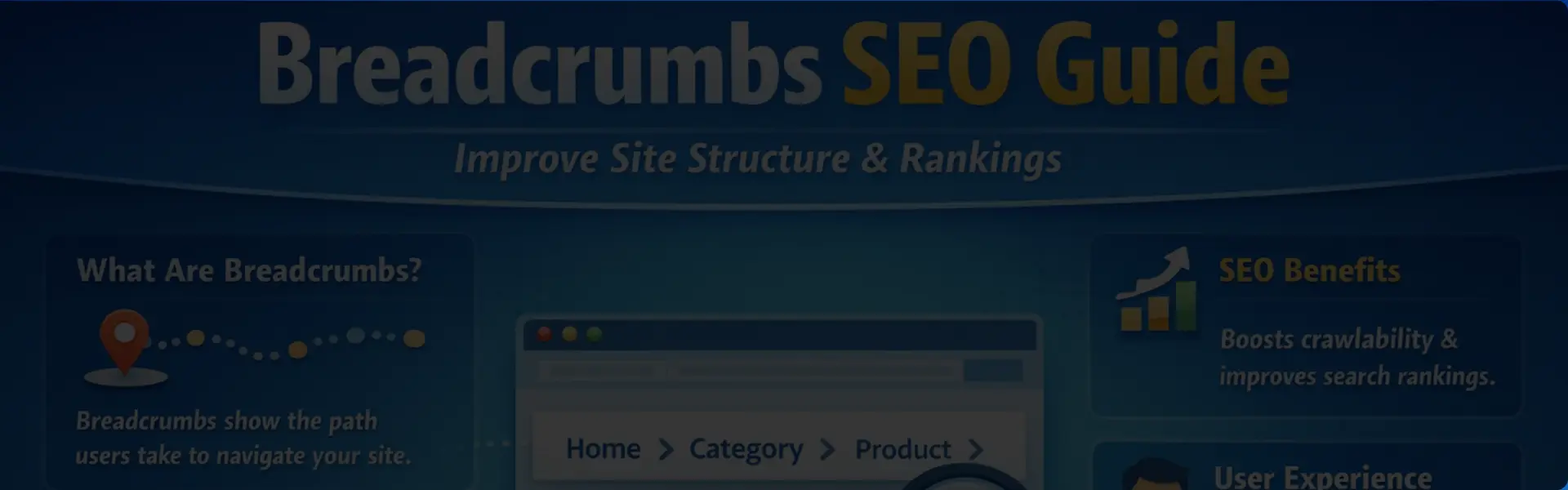
Breadcrumbs SEO in 2026: What They Are, Why They Matter & How to Implement Them
Search engines continue to evolve, but one technical SEO element has remained consistently useful: breadcrumbs SEO.
Breadcrumbs help users understand where they are on a website and allow search engines to better interpret the relationship between pages. While they may look like a small navigation feature, breadcrumbs can strengthen site structure, internal linking, crawlability, and search visibility.
In 2025, Google confirmed an important change: breadcrumbs are no longer shown in mobile search results, though they still appear on desktop. However, the underlying structured data and internal linking benefits remain valuable for SEO in 2026.
This guide explains what breadcrumbs in SEO are, why they matter today, and how to implement them correctly.
What are Breadcrumbs in SEO in 2026?
Breadcrumbs in SEO are secondary navigation links that show a page’s position within a website hierarchy. They appear as clickable paths like Home > Blog > SEO. These links help users navigate categories easily while helping search engines understand website structure.
They typically appear near the top of a page as a clickable path, such as:
Home > Blog > SEO > Breadcrumbs SEO
Each element in the path is a link that allows users to move back to higher-level pages.
For example, an e-commerce product page may show:
Home > Electronics > Laptops > Gaming Laptops > Product Name
This structure helps users understand how the content fits into the website and makes it easy to navigate between categories.
In SEO, breadcrumbs also function as automated internal links that connect pages together in a logical hierarchy.
Why Breadcrumbs SEO Still Matters in 2026
Even though breadcrumbs are no longer displayed in mobile search results, they still provide strong technical SEO value. Breadcrumbs support internal linking, help search engines understand page hierarchy, and improve website navigation, making them valuable for modern SEO strategies.
1. Improves Website Navigation and User Experience
Breadcrumbs act as navigation shortcuts. They allow visitors to quickly move to higher-level pages instead of repeatedly using the browser back button, improving navigation efficiency and making websites easier to explore.
Instead of clicking the browser’s back button several times, users can jump directly to a parent category.
For example:
Home > Digital Marketing > SEO > Technical SEO
If a visitor wants to explore more SEO topics, they can simply click SEO instead of leaving the site.
Better navigation often leads to:
- Longer session duration
- More page views
- Lower exit rates
These behaviors help users explore more content on the website.
2. Strengthens Internal Linking
Breadcrumbs automatically generate internal links between pages. Each breadcrumb connects pages to categories and parent sections, strengthening website architecture while helping search engines understand how pages relate.
For example, every product page links to:
- Its category page
- Its subcategory page
- The homepage
This means hundreds or thousands of pages naturally pass link equity upward.
This internal linking system helps search engines understand how pages relate to each other.
3. Improves Crawlability for Large Websites
Search engines discover pages through links. Breadcrumbs create additional navigation paths that help crawlers explore deeper pages quickly, improving indexing efficiency for large websites with extensive content.
Breadcrumbs provide additional navigation pathways that make it easier for crawlers to understand site structure.
For large websites with thousands of pages, breadcrumbs help:
- Discover deeper pages faster
- Reduce orphan pages
- Improve indexing efficiency
This is especially helpful for large e-commerce stores or content-heavy websites.
4. Helps Search Engines Understand Site Structure
Breadcrumbs clearly display hierarchical relationships between topics. When search engines see structured navigation paths, they better understand how pages relate, improving semantic context and organization.
Breadcrumbs show the hierarchy of topics on a website.
For example:
Home > Marketing > SEO > Technical SEO
This structure signals that:
- Technical SEO belongs under SEO
- SEO belongs under Marketing
Clear topic relationships help search engines understand the context and relevance of pages.
5. Can Improve Search Result Appearance
Breadcrumb structured data can replace long URLs in desktop search results. Instead of displaying raw URLs, search engines may show breadcrumb paths, creating cleaner search listings.
Instead of showing a long URL, the search result may display:
Home > SEO > Technical SEO
This cleaner structure can improve visibility and sometimes increase click-through rates.
Types of Breadcrumbs in SEO
Different websites use different breadcrumb structures depending on their architecture. Understanding breadcrumb types helps choose the best navigation structure for both user experience and SEO.
1. Hierarchy-Based Breadcrumbs (Most Common)
Hierarchy breadcrumbs show the exact position of a page in the website structure. They reflect category relationships and provide consistent navigation paths.
Example:
Home > Blog > SEO > Breadcrumbs SEO
This is the recommended breadcrumb type for SEO because it reflects the real site hierarchy.
It helps search engines clearly understand how pages are organized.
2. Attribute-Based Breadcrumbs
Attribute breadcrumbs reflect filters or selections used by users. They commonly appear on ecommerce websites where products are filtered by characteristics.
Example:
Home > Shoes > Running > Size 10 > Red
They are commonly used on e-commerce websites where products can be filtered by attributes.
These breadcrumbs help users track the filtering options used to find products.
3. Forward or Progress Breadcrumbs
Forward breadcrumbs display progress in multi-step processes such as checkout pages or registration forms, helping users track their position.
Example:
Step 1: Account Details > Step 2: Payment > Step 3: Confirmation
These are common in:
- checkout flows
- account setup pages
- form processes
They improve user experience but do not contribute much to SEO structure.
4. History-Based Breadcrumbs
History breadcrumbs display the path a user previously followed. Because navigation varies between users, this breadcrumb type rarely provides useful SEO signals.
Example:
Home > Article 1 > Article 2 > Current Page
This type is rarely used because it creates inconsistent navigation paths.
Since the path changes depending on user behavior, it provides little SEO value.
How Breadcrumbs Improve Site Architecture
Breadcrumbs play a critical role in technical SEO and site architecture by linking each page to its parent categories. This structured internal linking system improves crawlability, reinforces topical hierarchy, and helps search engines understand content organization across large websites.
A strong website structure helps search engines understand:
- page hierarchy
- content clusters
- topic relationships
Breadcrumbs reinforce this structure by linking each page back to its parent categories.
For example, a product page could automatically link to:
- Subcategory
- Category
- Department
- Homepage
If a website has 10,000 product pages, breadcrumbs generate thousands of internal links pointing to important category pages.
This strengthens category authority and helps search engines prioritize important pages.
Breadcrumb Structured Data Explained
Structured data allows search engines to interpret breadcrumb navigation accurately. Using BreadcrumbList schema markup provides information about hierarchy positions, page names, and URLs, helping search engines display structured breadcrumb trails.
The most commonly used format is JSON-LD using the BreadcrumbList schema.
Each breadcrumb item requires three key properties:
- position – order in the breadcrumb trail
- name – label shown to users
- item – URL of the page
Example structured data:
{
"@context": "https://schema.org",
"@type": "BreadcrumbList",
"itemListElement": [{
"@type": "ListItem",
"position": 1,
"name": "Home",
"item": "https://example.com/"
},{
"@type": "ListItem",
"position": 2,
"name": "SEO",
"item": "https://example.com/seo"
},{
"@type": "ListItem",
"position": 3,
"name": "Breadcrumbs SEO"
}]
}
The final item usually represents the current page and may not include a URL.
It is important that structured data matches the visible breadcrumb navigation on the page.
Best Practices for Breadcrumbs SEO in 2026
Proper implementation ensures breadcrumbs provide both user and SEO benefits. Following best practices ensures breadcrumbs support both SEO and user experience. Proper placement, consistent labelling, and correctly structured data help maintain clear navigation and reliable hierarchical signals.
Place Breadcrumbs Near the Top of the Page
Breadcrumbs should appear below the main navigation and above the page title so users can easily locate them without interrupting the primary content.
- below the main navigation
- above the page title
This makes them easy to find without distracting from the main content.
Keep the Breadcrumb Path Logical
Breadcrumb hierarchy should match the website structure and URL paths to avoid confusion for users and search engines.
Incorrect example:
Home > Products > Electronics > Phones
URL: /random-product-id
Correct example:
Home > Electronics > Phones > Smartphone
URL: /electronics/phones/smartphone
Consistency improves clarity for search engines.
Use Clear Category Names
Consistent category labels help users and search engines understand content relationships and prevent confusion.
Services
What We Do
Solutions
Use one consistent category name across the site.
Consistent labels strengthen semantic signals.
Always Use Canonical URLs
Breadcrumb links should always point to clean canonical URLs without tracking parameters, ensuring search engines recognize the preferred page version.
Avoid links containing:
- tracking parameters
- session IDs
- filter strings
Incorrect:
Category?
Correct:
Category
This prevents authority fragmentation.
Ensure Breadcrumbs Are Visible Without JavaScript
Breadcrumb navigation should be server-side rendered whenever possible.
If breadcrumbs only appear after JavaScript loads, some crawlers may not see them.
Visible HTML breadcrumbs are more reliable for SEO.
Common Breadcrumb SEO Mistakes
Even simple breadcrumb implementations can create issues if not handled properly. Avoiding common mistakes ensures breadcrumbs support SEO instead of creating confusion.
Inconsistent Breadcrumb Paths
Multiple breadcrumb paths leading to the same page can confuse search engines and weaken structural signals.
For example:
Home > Electronics > Laptops > Product
Home > Brand > Laptops > Product
Choose a primary category path to avoid confusion.
Missing Structured Data
Some websites add breadcrumbs visually but forget to implement structured data.
Without schema markup, search engines may not interpret the hierarchy correctly.
Replacing Navigation With Breadcrumbs
Breadcrumbs should supplement the main navigation, not replace it.
Users still need a clear primary navigation menu.
Breadcrumbs That Are Too Small
Breadcrumb text should be visible and clickable, especially on mobile devices.
Small text can create usability problems.
Breadcrumbs and Mobile SEO
Google’s mobile-first indexing means the mobile version of a website determines ranking and indexing.
Even though breadcrumbs are not shown in mobile search results, they still matter for:
- internal linking
- structured data
- site architecture
Modern mobile breadcrumb patterns include:
- horizontal scrolling breadcrumb trails
- collapsible breadcrumb menus
- truncated breadcrumbs with expandable paths
Regardless of the UI design, the structured data must include the full breadcrumb hierarchy.
The Future of Breadcrumbs SEO
Search engines increasingly rely on semantic relationships between topics. Breadcrumb navigation strengthens topical hierarchy signals, helping search engines understand how pages connect within a website’s overall structure.
Breadcrumbs provide strong signals about:
- topic hierarchy
- content clusters
- semantic relationships
For example:
Home > Marketing > SEO > Technical SEO > Core Web Vitals
This structure shows deeper topical coverage than a standalone article.
As AI-powered search systems continue to evolve, clear site architecture and structured navigation will become even more important.